
Corporate merch shouldn’t be stock sitting on a shelf that you hand out at reception a year later – it should be a daily tool that reminds employees, clients and trade‑show visitors of your brand.
In practice, that means smaller but smarter runs: a few well‑chosen apparel pieces, one or two “hero” extras, and a consistent graphic language across the set. This article is exactly about that – how to build merch that doesn’t end up as drawer decoration. It extends our service page corporate merch for companies and brands, but looks at it more from the decision‑making side: “What to order? For whom? And in what quality?”
What makes merch “great” vs. “wasted”
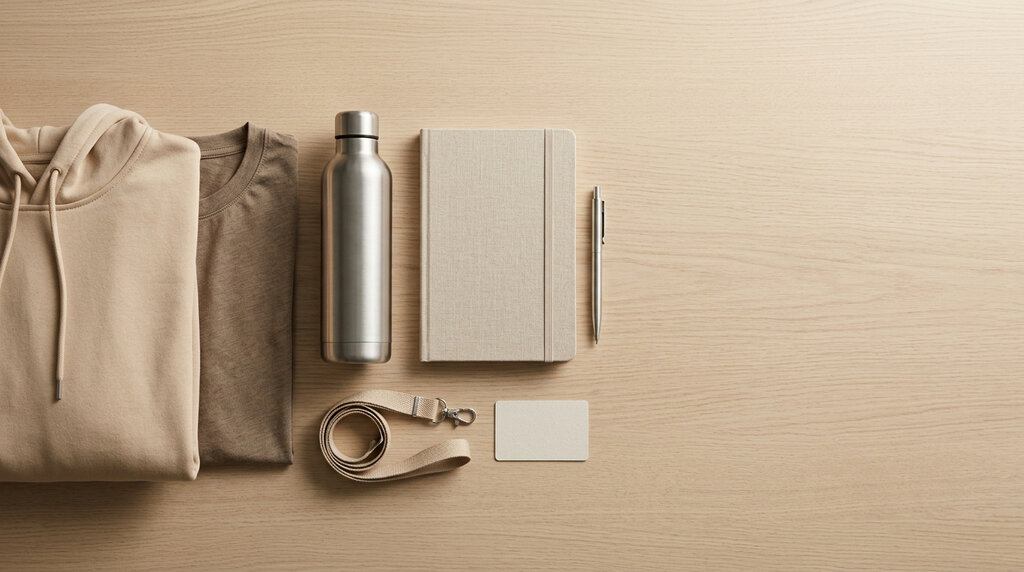
Great corporate merch has three traits: a clear goal, appropriate quality and visual consistency. Missing any of them, the investment crumbles – either people don’t use the items, or they look like cheap giveaways even if they were expensive.
- Goal: who it’s aimed at and why (hiring, employee retention, event presence, client appreciation).
- Quality: material, weight, finish and printing technology matching how often and where the item will be used.
- Consistency: same palette, fonts and logic for logo placement across all pieces.
Mentally tick these three boxes for every planned item. If it can’t meet at least two of them, it usually isn’t worth producing.
1. Employee merch and onboarding kits
Internal merch is specific because people receive it repeatedly and compare it among themselves. If it’s cheap, anyone who’s ever touched a good hoodie will notice. If it’s not wearable, it ends up in a closet – and so does your branding investment.
What tends to work long‑term in an onboarding kit:
- Apparel foundation: a hoodie and a t‑shirt with a subtle print. It pays off to choose by material and fit, not the lowest price, using our custom printed textiles category.
- One “everyday desk” item: a quality notebook, mug or thermo bottle – something the person uses each morning, so the logo is seen without being pushy.
- A small item that won’t get lost: a good printed pen they’ll gladly keep, instead of five plastic ones ending up in a drawer.
Field tip: if your budget is tight, dress the team in a better hoodie and trim the extras. Employees wearing that hoodie around town are still the best campaign you can buy.
2. Merch for trade shows, conferences and events
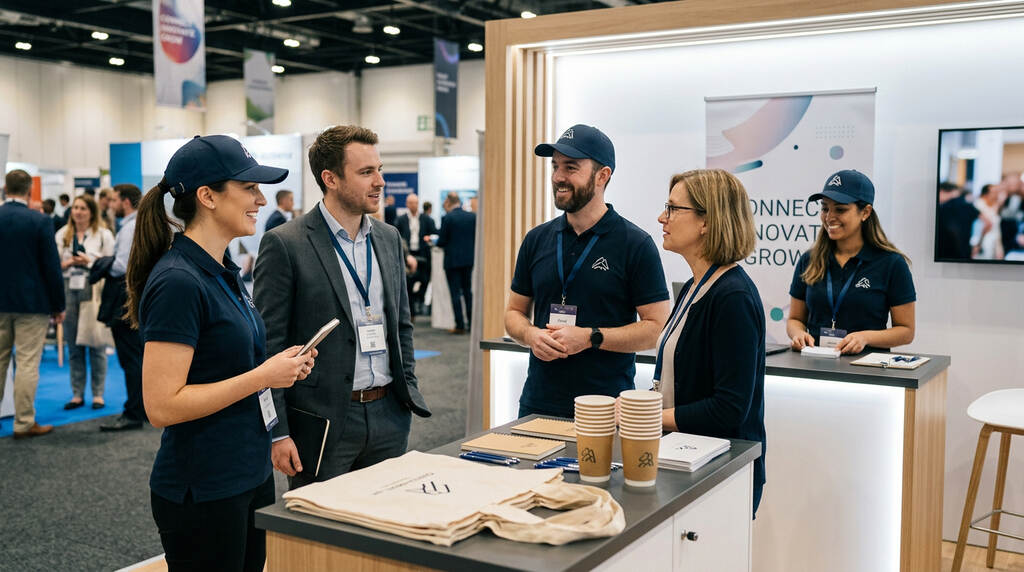
At events merch plays two roles: boosting team visibility and creating a “tangible memory” for the visitor. Both need different choices.
- Team: matching printed polo shirts or hoodies, plus a printed lanyard for badges. Our trade‑show checklist helps with what people typically forget.
- Visitor: one quality item they’ll actually take with them and use – a cotton tote, printed cup, notebook or reflective accessory. A few types at decent quality work better than a table overflowing with everything.
- Booth framing: visually matching roll‑up banner and other banners, so the merch becomes part of a scene, not a random pile.
Field insight: a limited wearable edition (cap, tee, tote) for the first few dozen visitors usually beats a bucket of tiny giveaways at the booth.
3. Merch for clients and partners
Simple rule here: give gifts you’d be proud to give to your own friends. In practice, it’s a shift from “how many pieces” to “how long it lasts” and “how it looks”.
- Premium thermos bottles, glassware or carafes – gifts that last years and don’t scream “promo”.
- Quality notebooks and writing sets – a perfect match with our luxury Parker gift pens with printing or engraving.
- A smaller, thoughtful bundle: 2–3 pieces in a gift box with a card, instead of ten random trinkets.
Printed apparel: where not to save
Apparel is the heart of your merch, so don’t just pick the cheapest option in the catalog. Four parameters help you decide quickly:
- Purpose: promotional one‑off giveaways vs. daily wear vs. workwear.
- Material: cotton feels softer and “nicer”, blends hold shape and survive frequent washing, technical fabrics fit sports and outdoor use.
- Weight: lightweight tees for summer and promo, heavier weights for hoodies meant to feel premium and last.
- Print: screen printing for large runs and color density, DTF/DTG for full‑color and small runs, embroidery for a premium feel on hoodies and polos.
If you’re unsure about size mix or fabric, start with a pilot run and fine‑tune the next order based on feedback.
Design and branding: less logo, more experience
The biggest design mistake isn’t “a bad font” – it’s cramming logos, slogans and arrows everywhere. Modern merch is built on subtle branding and a consistent visual language across items.
- A small logo on the chest or sleeve plus a bolder motif or slogan on the back.
- One dominant color + one accent, plus neutrals.
- The same visual language on the hoodie, mug, notebook and bag – people then remember “our collection”, not random pieces.
To nail this right from the start, use our 30 minutes of free graphic design. Send your logo and a rough idea; we’ll finalize it so everything works as one set, not separate items.
How much to order: a practical view of budget and volume
Instead of a pricing table, think in scenarios:
- Small company up to 30 people: matching tee + hoodie for the team, one premium extra (thermo bottle or notebook), rest of the budget into quality.
- Growing company, 30–150 people: onboarding kit + a seasonal refresh (e.g. summer tee, winter hoodie) + a client set.
- Event / trade show: one main giveaway in good quality (tote, cup, notebook) in the volume you realistically expect, plus a small “limited” batch for VIP contacts.
For most apparel and promo items, it makes sense to start from tens of pieces and re‑order in the same design later to build a stable brand collection.
Most common mistakes to avoid
- Deciding purely by lowest price, ignoring material and fit.
- A huge logo across the chest with no concept.
- Too many item types and too many colors – the result has no identity.
- Ordering at the last minute, leaving no space to polish design or quality.
- No plan for who receives the merch and when – it ends up in a box in the corner.
Pre‑order checklist
- Do we have a clear goal (onboarding, event, client, internal culture)?
- Do we know how many people will get it and the size range?
- Do we have 1–2 main apparel items + 2–3 matching extras, not ten different things?
- Are we sticking to the brand palette and a unified design across pieces?
- Is there time for graphic prep, proofing and production, or do we need express?
We’ll put it all together for you
If you don’t want to spend days comparing fabrics and print options, send us your brief and we’ll prepare a tailored merch proposal – including material recommendations, print variants and a quote.
- 30 minutes of free graphic design with every order.
- Data check before production, so nothing gets lost in translation.
- In‑house warehousing and production, so we can handle express deadlines too.
Request a free corporate merch quote
What’s the minimum quantity for corporate merch to make sense?
For most apparel and promo items you can start as low as a few dozen pieces. Design consistency and quality matter more than volume – fewer high‑quality items beat hundreds of cheap ones no one actually uses.
How do I choose between screen printing, DTF/DTG and embroidery?
Screen printing is ideal for large runs and simple graphics, DTF/DTG suits full‑color designs in smaller runs, and embroidery is perfect for hoodies and polos where you want a premium feel. We’ll recommend the technique based on your design and material.
Will you help us design the whole merch set, not just print?
Yes, every order includes 30 minutes of free graphic design, and we’re happy to help plan the entire package – apparel, extras, graphics and logistics – so the merch works as one set.
Can we have merch ready for an event in a few weeks?
For selected products we offer express production, so deadlines in days or weeks are often doable. We’ll always confirm a realistic timeline based on the apparel type and volume.